Skip to content

Terraform ECS module now supports environment variables

The Aembit Edge Terraform ECS module now supports Terraform variables that allow you to set Agent Controller and Agent Proxy environment variables directly.

You may now set logging levels for these Edge Components in AWS ECS Fargate environments, and leverage configuration options that the Edge Terraform ECS module doesn’t support directly as variables yet.

See AWS ECS Fargate documentation for more information..

Global Policy Compliance, OIDC ID Token Credential Provider, and Splunk Log Streams now available

To increase the available deployment options for Amazon Web Services (AWS) Lambda users, Aembit now provides a Lambda Layer to support zip-based Lambda Functions. This joins our existing AWS Lambda Container support.

For more detailed information on how to deploy Aembit Edge Components to AWS Lambda Functions using our Lambda Layer, please refer to the AWS Lambda Functions documentation.


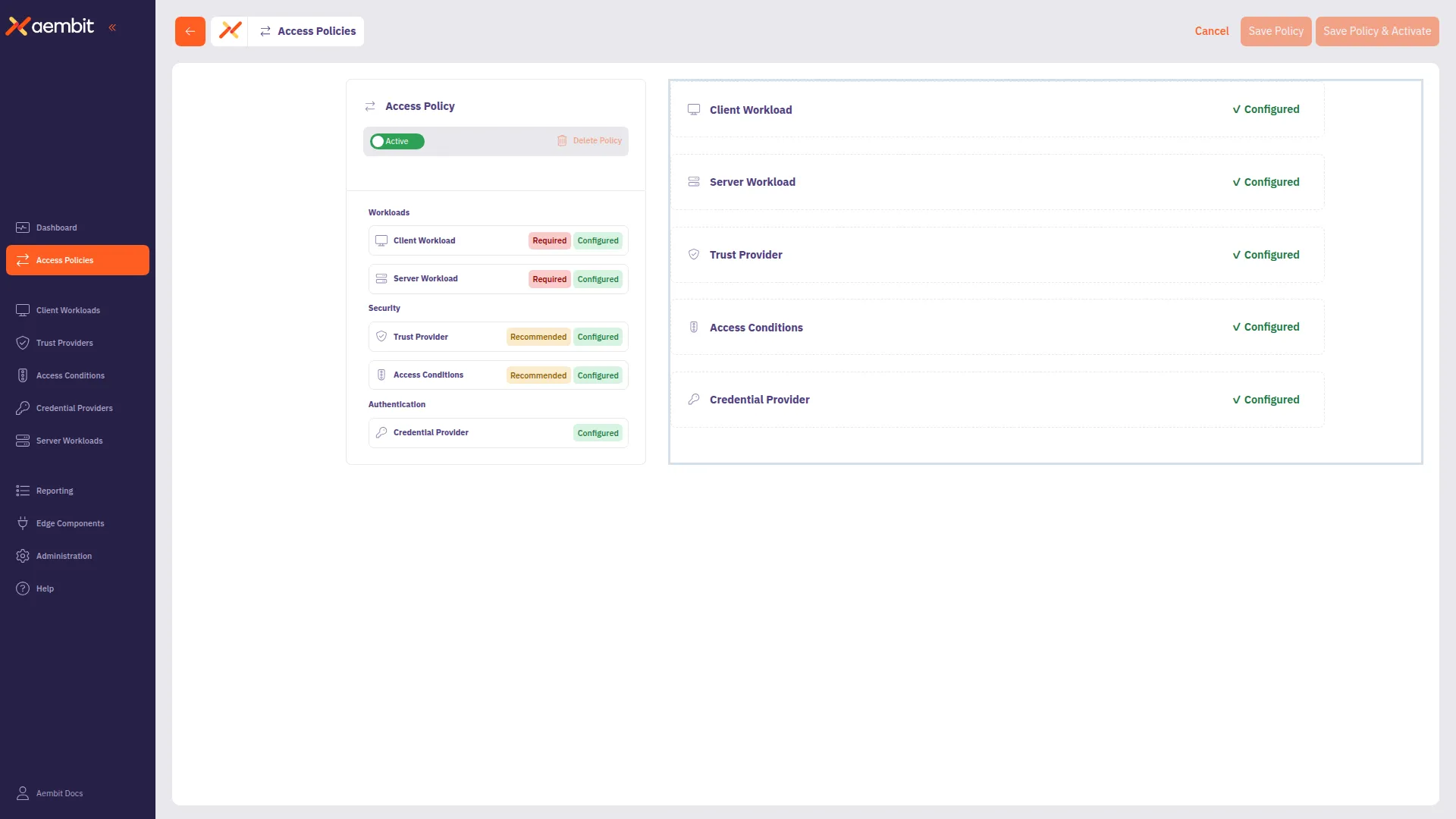
Introducing Global Policy Compliance for centralized security enforcement across your Aembit environment. This feature allows administrators to establish organization-wide security standards for Access Policies and Agent Controllers, ensuring consistent security practices and preventing the creation of policies that might inadvertently expose resources.

With Global Policy Compliance, you can enforce requirements for Trust Providers and Access Conditions across all Access Policies, as well as Trust Provider and TLS Hostname requirements for Agent Controllers. The three-tier enforcement model lets you set requirements as Required, Recommended (default), or Optional based on your organization’s security needs.

Global Policy Compliance visually identifies non-compliant components through color-coded status icons:

  • Red indicators for required but missing elements
  • Yellow indicators for recommended but missing elements
  • Green indicators for compliant Access Policies
  • Gray indicators for disabled or not active Access Policies

To learn more about Global Policy Compliance, see the Global Policy Compliance Overview.


Introducing OIDC ID Token Credential Provider for secure identity token generation and exchange with third-party services. By leveraging Aembit’s custom Identity Provider (IdP) capabilities, this Credential Provider generates JWT-formatted tokens that seamlessly integrate with various Workload Identity Federation (WIF) solutions.

The OIDC ID Token Credential Provider offers flexible configuration options including:

  • Custom claims configuration with both dynamic and literal subject support
  • Choice of signing algorithms (RS256 or ES256)
  • Integration with identity brokers such as AWS STS, GCP WIF, Azure WIF, and HashiCorp Vault

This new Credential Provider is particularly valuable for:

  • Secure access to cloud provider resources through their WIF solutions
  • Authentication with HashiCorp Vault using OIDC tokens
  • Integration with any service supporting OIDC/JWT authentication

To learn more about this feature, see About the OIDC ID Token Credential Provider.


Introducing Log Stream for Splunk SIEM to enhance your security monitoring capabilities. This integration enables rapid streaming of Aembit Edge event logs and audit logs directly to Splunk using Splunk’s HTTP Event Collector (HEC) protocol.

By connecting Aembit with Splunk SIEM, you can:

  • Enhance threat detection with comprehensive security data
  • Improve incident management through centralized logging
  • Streamline compliance monitoring for your organization

The setup process is straightforward, requiring only a properly configured HTTP Event Collector in your Splunk environment and a few configuration steps in the Aembit Admin UI. Aembit will automatically send email notifications if Log Stream transactions consistently fail, ensuring you’re always aware of your logging status.

To learn more about setting up this integration, see How to stream Aembit events to Splunk SIEM.

Pod startup delay and security enhancements for Agent Proxy

Aembit has added the AEMBIT_PASS_THROUGH_TRAFFIC_BEFORE_REGISTRATION Agent Proxy environment variable to enable you to delay the Client Workload Kubernetes pod startup until registration between Agent Proxy and Agent Controller completes. See Delaying pod startup until Agent Proxy has registered for details.


Aembit has applied security enhancements and hardening to Agent Proxy in this release.


Updated Edge Components:

  • Agent Proxy

Updated Edge Packages:

  • Helm Chart

  • VM Agent Proxy package

  • Terraform ECS module

  • AWS Lambda Extension

See Edge Components supported versions for more details.

Allowed TLS Hostname now configurable for Agent Controller

Agent Controllers now support Allowed TLS Hostname as a configurable field in your Aembit Tenant:

Create an Agent Controller with TLS Hostname field

Allowed TLS Hostname serves the same purpose as the AEMBIT_MANAGED_TLS_HOSTNAME Agent Controller environment variable.

Configuring an Allowed TLS Hostname allows you to specify which domain name Aembit Managed TLS includes in the TLS certificate. This makes sure secure connections from your Agent Proxies are only valid when using this exact domain name to reach your Agent Controller, enhancing security without restricting which Agent Proxies can communicate with it.

To configure your Agent Controller with an allowed TLS hostname, see How to create and Agent Controller or Configure Agent Controller TLS with Aembit’s PKI.

Standalone CAs and Credential Provider Integrations now available

Introducing Standalone CAs for more granular control over TLS Decrypt management. This feature allows you to create and manage dedicated Certificate Authorities (CAs) that function independently from Aembit’s default Tenant-level certificates.

With Standalone CAs, you can assign CAs directly to specific Client Workloads or Resource Sets, creating isolated trust boundaries and enabling precise management of TLS traffic across different environments. Aembit intelligently selects the appropriate CA using a clear hierarchy: Client Workload level -> Resource Set level -> Tenant level.

To learn more about Standalone CAs, see About Standalone CA for TLS Decrypt.


We’ve updated the Deploy Edge Components experience in the Aembit admin UI to streamline how you deploy Aembit Edge Components.

We’ve added deployment guides directly in the Aembit admin UI for each type of deployment such as Kubernetes, Ubuntu Linux, Red Hat Enterprise Linux, or Microsoft. Now when you’re deploying new Aembit Edge Components, you’ll have a guided experience to get you up and running faster.

Deploy Aembit Edge screen


Introducing Credential Provider Integrations, which automate credential lifecycle management for third-party systems. This feature makes sure your workloads always have valid credentials without manual management, enhancing both security and operational efficiency, eliminating manual credential management.

Our new Credential Provider Integrations feature makes this possible by connecting Aembit directly to third-party systems like with the GitLab Service Account integration. The GitLab Service Account integration enables you to create a Managed GitLab Account Credential Provider, which allows you to manage the credential lifecycle of your GitLab service accounts.

This gives you fine-grained control while eliminating the overhead of manual credential management.

AWS SigV4 and SigV4a request signing now supported

The Aembit Credential Provider for AWS Security Token Service (STS) now supports the AWS SigV4 and SigV4a request signing protocols. Aembit automatically signs requests to AWS services using SigV4 for regional services or SigV4a for global/multi-region services.

See How Aembit uses AWS SigV4 and SigV4a to learn more and AWS Security Token Service (STS) Federation to configure an AWS STS Credential Provider.

Updated Edge Components:

  • Agent Proxy

Updated Edge Packages:

  • Helm Chart

  • VM Agent Proxy package

  • Terraform ECS module

  • AWS Lambda Extension

See Edge Components supported versions.

Vault private network access and CrowdStrike on Windows now available

Aembit now supports accessing HashiCorp Vault Credential Providers that reside on private networks. This allows your colocated Agent Proxy to handle authentication directly instead of Aembit Cloud. See Accessing Vault on private networks for more info.

Aembit now supports Conditional Access for CrowdStrike on Windows. To set up Conditional Access for CrowdStrike on Windows, follow the steps in Access Condition for CrowdStrike.

Aembit now supports the AWS Role Trust Provider on Agent Proxy for ECS Fargate deployments.

Enhanced Vault token header behavior.

Enhanced Agent Proxy initialization on Kubernetes to prevent other processes from interfering and impacting its startup.

Updated Edge Components:

  • Agent Proxy

Updated Edge Packages:

  • Helm Chart

  • Terraform ECS module

  • VM Agent Proxy package

  • AWS Lambda Extension

See Edge Components supported versions.

Azure Entra Workload Identity Federation and automatic user creation now available

Aembit now supportsAzure Entra Workload Identity Federation as a Credential Provider. This enables you to automatically obtain credentials through Aembit as a third-party federated Identity Provider (IdP) to securely authenticate with Azure Entra to access your Azure Entra registered applications and managed identities.

Aembit now supports Automatic User Creation triggered by SSO login requests. Aembit has enhanced the Identity Provider configuration page with additional parameters, enabling you to map SAML attributes from your Identity Provider to the user roles defined in your Aembit Tenant.

You can now change the leaf certificate lifetime when using the TLS Decrypt feature.

RHEL with SELinux now supported for Edge components

Aembit Edge Components have been updated to include support for RedHat Enterprise Linux (RHEL) 8 and 9 with Security-Enhanced Linux (SELinux). With this improvement, administrators may now add additional layers of security to their system architecture.

For more information on integrating Aembit Edge Components with SELinux, please see the SELinux support page.

Aembit Virtual Appliance now available for Edge components

Aembit has released a new, pre-packaged deployment model that enables you to use a Virtual Appliance configuration and setup for deploying Aembit Edge Components in your environment. This virtual appliance image includes both Agent Controller and Agent Proxy bundled together in a single OVA file.

For more detailed information on how to deploy the Aembit Virtual Appliance, please see the Virtual Appliance technical documentation.