Skip to content

Expanded MCP and AI IAM event coverage

Aembit has expanded the event coverage and reporting surfaces for troubleshooting MCP and AI IAM failures:

  • New access.discovery event type: Access Authorization Events now include an access.discovery event that lists the Client Workloads and Server Workloads Aembit Cloud considered during evaluation. Use it to diagnose requests that match no workload or policy, or that match multiple. See Access Discovery events.
  • User identity on MCP Workload Events: MCP Workload Events now include a userId field at application.mcp.userId for flows that involve a human identity, such as MCP Authorization Server flows. The Workload Events view exposes a matching User (MCP App Protocol only) filter for per-user investigations and SIEM scoping.
  • Trust Provider failures emit at Error severity: Trust Provider attestation failures in MCP flows now emit at Error severity rather than warning, so SIEM alerts that watch for Error events catch real authorization failures reliably.
  • Clearer expired-credential explanations: The access.credential event’s reason now identifies which token expired and at which step, making it easier to decide between re-authentication, credential refresh, or Credential Provider reconfiguration.
  • MCP Authorization Tracing view: A new live diagnostic view in the Reporting dashboard surfaces inbound authorization requests at the MCP Identity Gateway in real time, with the redirect URI, resource, matched Client Workload, and policy outcome for each request. See MCP Authorization Tracing.

For an end-to-end investigation flow that uses these reporting surfaces together, see Troubleshoot MCP and AI IAM access.

Workload Discovery filtering and Global Policy Compliance reporting now available

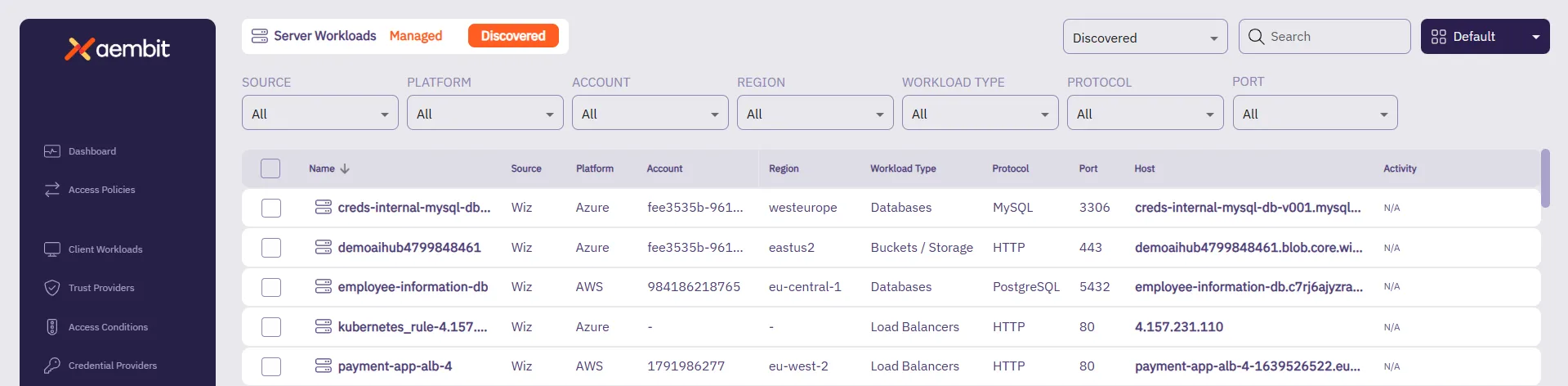
Introducing Workload Discovery Filtering for improved workload management and visibility across your discovered infrastructure. This enhancement adds comprehensive filtering capabilities to both Client Workloads and Server Workloads discovery pages, enabling you to quickly locate and analyze specific workloads.

Filtering options include:

  • Client Workloads: Filter by Client Workload Identifiers and Workload Discovery Source
  • Server Workloads: Filter by Port, Protocol, and Workload Discovery Source

Server Workload discovery filtering

This feature streamlines workload management by enabling you to efficiently search through discovered workloads, making it easier to identify, analyze, and onboard relevant workloads into your Aembit environment.

To learn more about discovered workload filtering, see Workload Discovery Filtering.


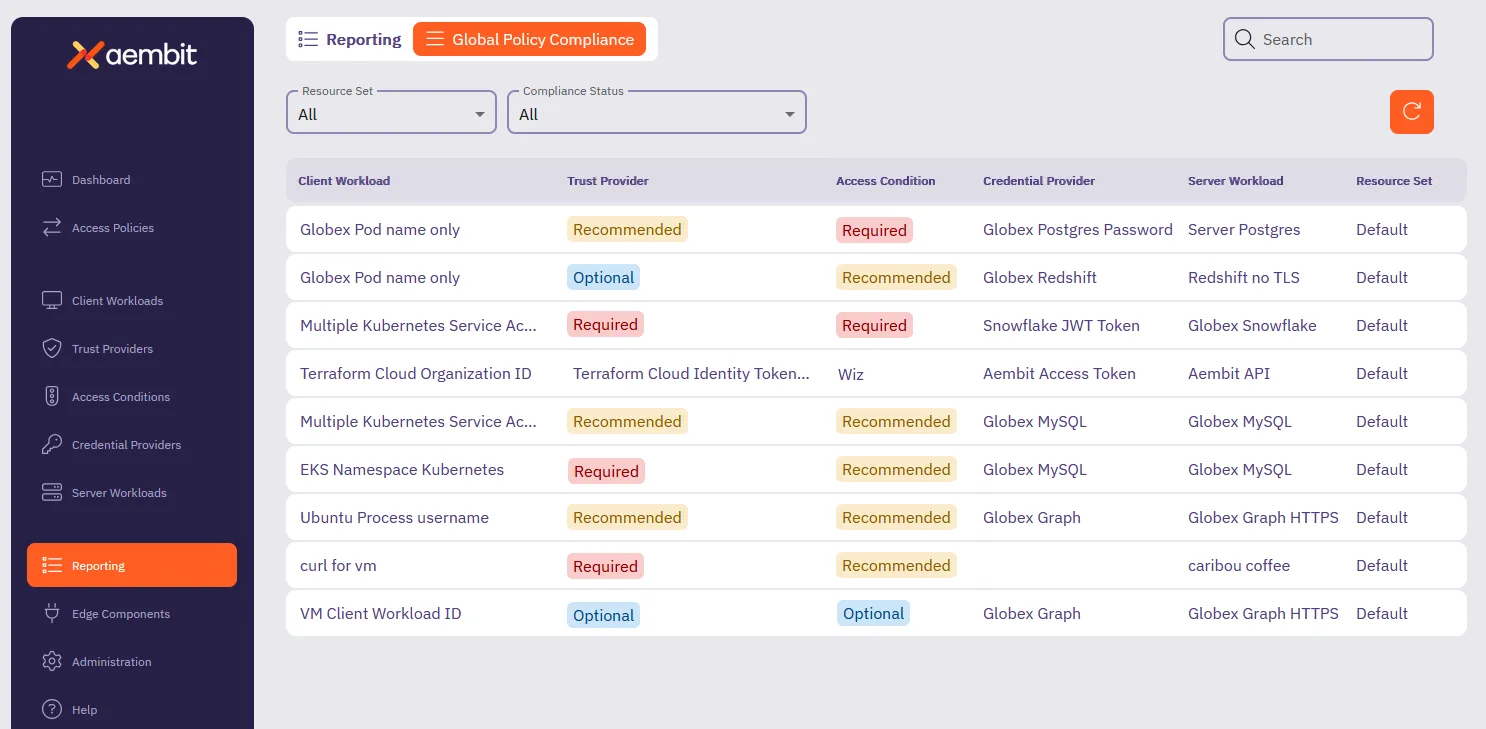
You can now view the Global Policy Compliance status of your Access Policies using the new Global Policy Compliance page under Reporting in the left nav menu. Quickly get an overall view of the compliance status of your Access Policies and optionally filter for specific statuses.

Global Policy Compliance report dashboard

To learn more about reporting on Global Policy Compliance status, see How to review Global Policy Compliance.

CrowdStrike SIEM Log Streams and Agent Proxy enhancements

Introducing Log Streams for CrowdStrike Next-Gen SIEM for real-time security event monitoring and enhanced threat detection. This integration enables rapid streaming of Aembit Edge event logs and audit logs directly to CrowdStrike’s Next-Gen Security Information and Event Management (SIEM) platform using the HTTP Event Collector (HEC) protocol.

By connecting Aembit with CrowdStrike Next-Gen SIEM, you can:

  • Stream Access Authorization Events, Audit Logs, and Workload Events to CrowdStrike SIEM
  • Configure TLS encryption and verification options
  • Automatic failure notifications for Aembit admins
  • Seamless integration with existing CrowdStrike HEC configurations

This feature enhances your organization’s security posture by improving threat detection capabilities, streamlining incident management, and supporting compliance monitoring requirements through centralized log analysis in CrowdStrike.

To learn more, see Log Streams for CrowdStrike Next-Gen SIEM.


Aembit has applied security and performance enhancements to Agent Proxy in this release.


Aembit has added the AEMBIT_CLIENT_WORKLOAD_PROCESS_IDENTIFICATION_ENABLED Agent Proxy environment variable to Enable Process Name Client Workload identification.


Updated Edge Components:

  • Agent Proxy

Updated Edge Packages:

  • Helm Chart

  • VM Agent Proxy package

  • Terraform ECS module

  • AWS Lambda Extension

  • AWS Lambda Layer

See Edge Components supported versions for more details.

Global Policy Compliance, OIDC ID Token Credential Provider, and Splunk Log Streams now available

To increase the available deployment options for Amazon Web Services (AWS) Lambda users, Aembit now provides a Lambda Layer to support zip-based Lambda Functions. This joins our existing AWS Lambda Container support.

For more detailed information on how to deploy Aembit Edge Components to AWS Lambda Functions using our Lambda Layer, please refer to the AWS Lambda Functions documentation.


Introducing Global Policy Compliance for centralized security enforcement across your Aembit environment. This feature allows administrators to establish organization-wide security standards for Access Policies and Agent Controllers, ensuring consistent security practices and preventing the creation of policies that might inadvertently expose resources.

With Global Policy Compliance, you can enforce requirements for Trust Providers and Access Conditions across all Access Policies, as well as Trust Provider and TLS Hostname requirements for Agent Controllers. The three-tier enforcement model lets you set requirements as Required, Recommended (default), or Optional based on your organization’s security needs.

Global Policy Compliance visually identifies non-compliant components through color-coded status icons:

  • Red indicators for required but missing elements
  • Yellow indicators for recommended but missing elements
  • Green indicators for compliant Access Policies
  • Gray indicators for disabled or not active Access Policies

To learn more about Global Policy Compliance, see the Global Policy Compliance Overview.


Introducing OIDC ID Token Credential Provider for secure identity token generation and exchange with third-party services. By leveraging Aembit’s custom Identity Provider (IdP) capabilities, this Credential Provider generates JWT-formatted tokens that seamlessly integrate with various Workload Identity Federation (WIF) solutions.

The OIDC ID Token Credential Provider offers flexible configuration options including:

  • Custom claims configuration with both dynamic and literal subject support
  • Choice of signing algorithms (RS256 or ES256)
  • Integration with identity brokers such as AWS STS, GCP WIF, Azure WIF, and HashiCorp Vault

This new Credential Provider is particularly valuable for:

  • Secure access to cloud provider resources through their WIF solutions
  • Authentication with HashiCorp Vault using OIDC tokens
  • Integration with any service supporting OIDC/JWT authentication

To learn more about this feature, see About the OIDC ID Token Credential Provider.


Introducing Log Stream for Splunk SIEM to enhance your security monitoring capabilities. This integration enables rapid streaming of Aembit Edge event logs and audit logs directly to Splunk using Splunk’s HTTP Event Collector (HEC) protocol.

By connecting Aembit with Splunk SIEM, you can:

  • Enhance threat detection with comprehensive security data
  • Improve incident management through centralized logging
  • Streamline compliance monitoring for your organization

The setup process is straightforward, requiring only a properly configured HTTP Event Collector in your Splunk environment and a few configuration steps in the Aembit Admin UI. Aembit will automatically send email notifications if Log Stream transactions consistently fail, ensuring you’re always aware of your logging status.

To learn more about setting up this integration, see How to stream Aembit events to Splunk SIEM.
Explicit steering and enhanced access authorization events now available

Aembit regularly releases new enhancements and improvements to Aembit Edge and Aembit Cloud components to provide additional features and functionality for your Aembit environment.

The following new features and enhancements have been released:

  • Enhanced Access Authorization Events
  • Explicit Steering
  • Updated Aembit Edge Component Versions

Enhanced Access Authorization Events

Aembit automatically records and collects various types of workload metadata in access authorization events, enabling you to use this information to audit and analyze security events.

The information collected and recorded in these access authorization events has been enhanced to now capture and display additional workload metadata, including VM hostname, IP address, and process name.

For more information on access authorization events, please refer to the following technical documentation pages:

Explicit Steering

Aembit continues to look for ways to improve the overall user experience in an Aembit environment, while also providing additional functionality and features that enhance this experience. One of these ways is by enabling you to route only specific types of traffic through Aembit, via the explicit steering feature.

With explicit steering, you can now configure Client Workloads to direct only certain types of traffic to the Agent Proxy. This enables you to have more precise control of which traffic is managed by the Agent Proxy.

For more information on the explicit steering feature, please refer to the Explicit Steering page.

Aembit Edge Components Update

Aembit Edge Components have been updated to newer versions to improve overall performance and functionality.

The following components and packages have been updated:

  • Helm Chart
  • Agent Controller
  • Agent Proxy

For the latest available versions of these components, please see the Edge Components Supported Versions page.

Improved access authorization events and audit logging

Aembit has released improvements to its reporting and logging/auditing capabilities, giving you improved visibility into access authorization events and audit logs. With these enhancements, you can more easily diagnose issues and troubleshoot problems in your environment.

Improved Access Authorization Events and Audit Logging

Improvements have been made to the Aembit Tenant’s reporting capabilities and reporting documentation, enabling increased visibility into access authorization events and audit logs. The Aembit technical documentation has also been augmented to assist with using these capabilities.

For more information on these access authorization event and audit log improvements, please see the following pages:

GeoIP Access Conditions and Google Cloud Storage Log Streams now available

Aembit has released two new features on Aembit Cloud:

  • Access Condition support for Geographic IP (GeoIP) restrictions
  • Log Stream support for streaming to Google Cloud Storage Buckets

Aembit GeoIP Access Conditions

You may now configure and add Aembit GeoIP conditions in your Aembit Tenant. This new Access Condition type enables you to explicitly designate which countries/regions will have access to Server Workloads from policy-enabled Client Workloads.

For more information on this feature, please refer to the Access Conditions for GeoIP Restriction page.

Google Cloud Storage Bucket Log Streams

Aembit now supports Log Streams that target Google Cloud Storage (GCS) Buckets. You may add or configure this new Log Stream destination type in the Administration tab of your Aembit Tenant.

For more information on this feature, please refer to the Google Cloud Storage Bucket Log Streams page.

Access Authorization Events and Google Cloud Run Jobs support now available

Support for Access Authorization Events

Aembit has now enabled support for Access Authorization Events. Access Authorization Events enable customers to observe credential requests.

Support for Google CloudRun Jobs as Client Workloads

Aembit supports Google CloudRun Jobs as Client Workloads. With this support, you can now:

  • authenticate to the Aembit IdP using Attestation with the GCP Cloud Run Job Identity

  • request and retrieve a secret from GCP Secret Manager